HotGifs
HotGIFs.ai: Realistic AI Video Generator with Short-Form Discovery Feed
DeepUndress: A New AI Visual Platform for Images, Face Swap, and Short-Form Creative Generation
This page is based on editorial research and publicly available product information; it is not a hands-on test. Last checked: September 4, 2026
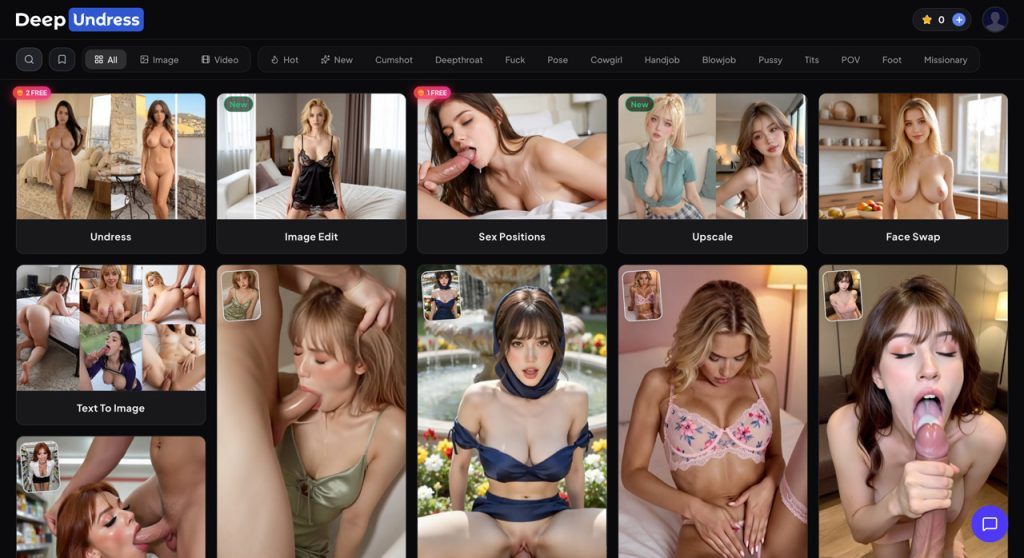
DeepUndress has grown beyond the simple AI undress concept suggested by its name. The current platform brings together photo transformation, AI image generation, face swap, image editing, upscaling, custom scene creation, and image-to-video tools inside the same account.
That wider toolbox is what makes DeepUndress interesting today. You can use a quick preset when you want a straightforward result, work from an existing photo, personalize a scene with a face reference, or move into more flexible image generation when you want greater control.
DeepUndress offers several different generation workflows rather than building the entire service around a single tool.
Photo transformation is still an important part of the platform, but it now sits alongside AI image generation, face swap, image editing, image enhancement, scene generation, and short-form AI video.
The scene generator is one of the more useful additions. Instead of expecting you to write a detailed prompt from scratch, it lets you upload a face reference, choose a category, adjust additional options, select an aspect ratio, and decide how many variations you want to create.
DeepUndress currently supports several common image formats, including square, portrait, landscape, and vertical ratios. Some generators also allow multiple results to be created in a single run, which is useful when you want to compare variations rather than repeatedly starting the same job.
One of the biggest differences between the current DeepUndress and older versions of the service is that you are no longer limited to modifying an uploaded photograph.
The image generation tools give you more freedom to create new visuals, while the editor is better suited to cases where you already like most of an image and only want to change or refine part of it.
There is also an upscale and enhancement workflow for improving an existing result rather than generating everything again. Having these tools together is convenient because you can move from creation to editing and refinement without switching between several unrelated services.
Face swap gives DeepUndress another useful entry point for users who prefer working from existing images. You provide the source material and a face reference, then let the generator create the transformed result.
The custom scene tools take that idea further by combining a face reference with ready-made categories and generation settings. This sits somewhere between a simple preset and an open-ended AI generator: there is enough control to personalize the result without requiring you to become good at prompting first.
As with any face-based AI tool, the quality of the source image matters. Clear facial features, sensible framing, and similar viewing angles generally give the model more useful information to work with than blurry, heavily cropped, or partially hidden faces.
DeepUndress also includes image-to-video generation, allowing a still image to be turned into a short animated clip.
The video side is largely template-driven, which keeps the process simple. Instead of configuring a video model manually, you choose the type of animation you want and generate from the source image.
This makes video generation accessible, although it can also use credits more quickly than basic image jobs. Users planning to experiment with several animations should therefore pay more attention to generation costs than someone who only creates occasional images.
Despite having more tools than its name might suggest, DeepUndress remains relatively easy to navigate. Most workflows follow the same pattern: choose a tool, provide the required image or prompt, select the available settings, review the credit cost, and generate.
We prefer this approach to platforms that expose dozens of technical AI settings before you can create anything. DeepUndress gives casual users presets and guided tools while still providing more flexible generation options for people who want to experiment.
The downside is that some of the tools overlap. New users may need a little experimentation before they understand whether a particular idea is better handled by the editor, scene generator, image generator, or one of the ready-made transformations.
DeepUndress uses credits across its generation tools, with the number of credits required depending on what you create. Simpler image jobs generally cost less, while more demanding generations such as video or multiple variations can use your balance faster.
The service also offers paid access for users who generate more frequently. Because plan prices, included credits, and promotional offers can change, it is worth comparing the current options before paying for a longer plan.
The strongest part of DeepUndress is the amount you can do without leaving the platform. What used to feel like a specialized transformation service now covers several stages of an AI image workflow.
You can start from a photograph, generate something new, swap a face, create a custom scene, refine an image, improve its quality, or turn a still result into a short video.
We also like the balance between presets and customization. Beginners do not have to learn detailed prompting immediately, while users who want something less generic have more options than simply choosing one fixed transformation.
More tools do not automatically mean every workflow is equally useful. There is some overlap between the different generators, and the growing number of options makes DeepUndress less immediately simple than it once was.
Results can also vary considerably depending on the source image, pose, lighting, framing, and selected mode. AI image transformation is still not completely predictable, so generating several variations may be necessary before you find one worth keeping.
That experimentation can become expensive when each attempt consumes credits, particularly with video generation or more demanding processing modes. It is a good idea to learn which tools work best for your images before repeatedly generating large batches.
DeepUndress is an adults-only platform, and its generation interface requires users to accept its policies before continuing.
The service also warns users about processing photographs of other people without permission. That is especially important with face swap and adult image transformation tools. Only upload images you own or have clear permission to use, and never use images involving minors.
We would treat any personal photo uploaded to an AI service as sensitive material regardless of the platform’s stated privacy protections.
DeepUndress is much more capable than the name initially suggests. It still provides the photo-transformation tools that made the service recognizable, but image generation, face swap, editing, custom scenes, upscaling, and video generation now make it feel more like a complete adult AI visual toolkit.
Its best feature is convenience. You can handle several different image and video workflows from one account without setting up local AI models or moving files between multiple specialist services.
Users who only want one quick transformation may not need everything DeepUndress now offers, while frequent experimentation can consume credits quickly. For anyone looking for a broader combination of adult AI image creation, editing, face swap, and short video tools, however, DeepUndress has become considerably more versatile than a basic AI undress app.
Visit the official site to explore features, pricing, and the latest updates.
Try DeepUndress.app Now